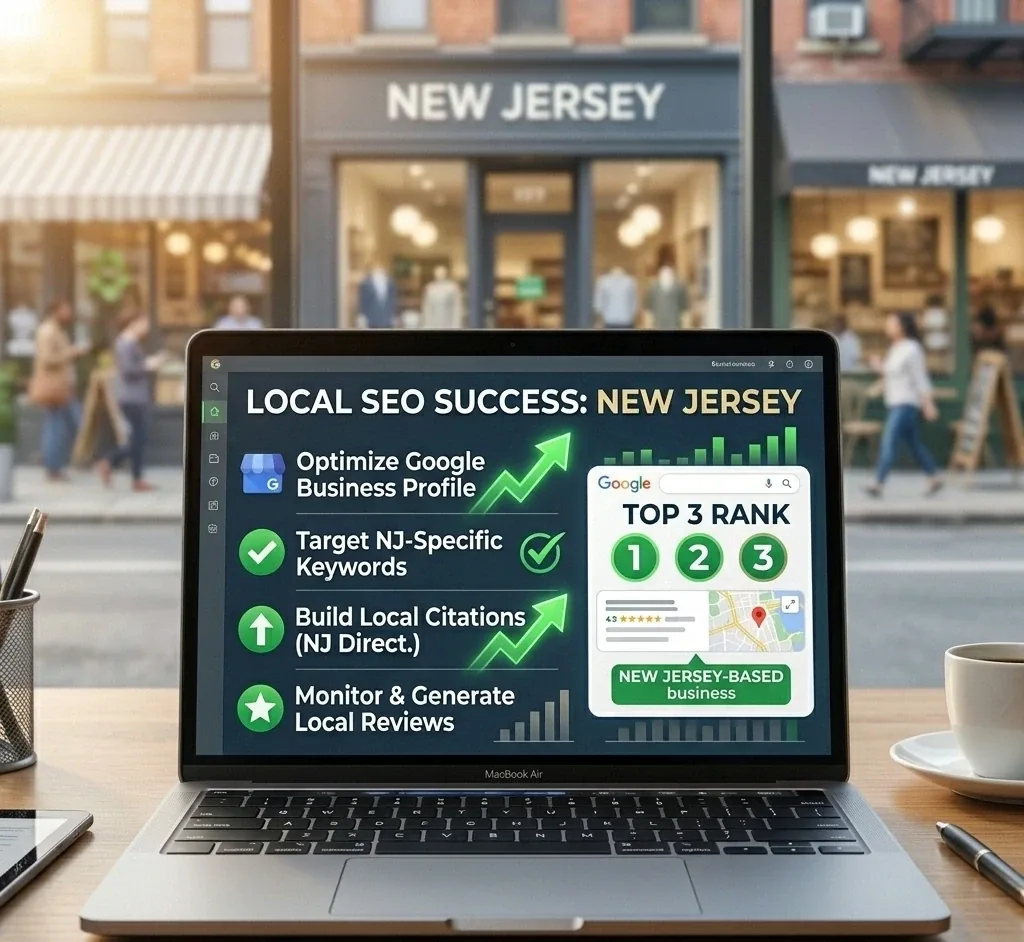
The short answer
Work in this order: complete the Google Business Profile, fix the pages people land on, then build reviews and genuinely local content. Profile changes can move the map results within days. Site and review work compounds over months, and in dense New Jersey markets proximity still caps how far it goes.
The profile comes before the website
Your Google Business Profile decides whether you appear in the three map results, and those three take a large share of local clicks before anyone scrolls to the ordinary listings. No amount of on-site work substitutes for it. So the first two weeks go to the profile, every time, and the rest of this is the order we work in after that.
Get the profile genuinely complete
Primary category first, and be specific. Contractor and Roofing Contractor are not close to the same thing in Google's eyes, and the primary carries far more weight than the secondaries. Then hours, the services listed individually rather than as a paragraph, and photos that are recent rather than flattering.
One setting worth checking carefully: if you travel to customers rather than serving them at a counter, hide the address and set service areas instead. A storefront address you do not actually work from is one of the more common causes of a suspension, and reinstatement takes weeks you cannot afford in season.
Add a tracking tag to the website link on the profile, something like a utm_source of google and a utm_medium of gbp. Without it, that traffic arrives in analytics looking like ordinary organic search, and you will badly underestimate how much of your business the profile produces. Most owners are surprised by the real figure the first time they see it separated out.
Use the words your customers type
Keyword tools give you the polished version of a phrase, because the polished version is what other websites already published. Your phone log and your inbox have the real one. Homeowners do not search for residential HVAC solutions. They search for why is my ac not blowing cold and how much to replace a furnace.
Put those phrases in a heading and in the first two sentences of the page that answers them, then stop. Repetition past the point of readability stopped helping years ago, and it costs you the sale even in the cases where it holds the ranking.
Citations: fix the broken ones, ignore the rest
Directory listings do less for ranking than they did five years ago, and inconsistency across them still causes real problems. The ones worth your time are the ones Google and customers actually check: Apple Business Connect, Bing Places, Yelp, the Better Business Bureau, and your state license board if your trade has one.
The failure we see most often is a call tracking number. A business swaps its number on the website for a tracked one, leaves the original on forty directories, and now nothing matches anything. Use dynamic number insertion so the underlying number stays consistent everywhere, and keep your real main line on the profile itself.
Ask for reviews at the only moment that works
The moment the job ends and the customer is visibly pleased is the moment. A text sent from the truck before you pull away converts several times better than an email two weeks later, when the relief has worn off and your name has gone out of their head. Use the short review link from the profile so nobody has to search for you first.
Reply to all of them, including the bad ones, briefly and without defending yourself. Prospective customers read the replies more carefully than they read the reviews, and one calm reply to a one-star review does more for you than three more five-star reviews would.
What "local content" means if you are not a publisher
You do not need a posting schedule. You need a small number of pages that only your business could have written. A page about the town you work in most, naming the neighborhoods and the housing stock and describing a job you actually did there. A page that answers the question you get asked on every single estimate, written the way you say it out loud.
Ten of those beat a hundred generic posts, and you can write one a month without hiring anybody. Our Red Bank page is the shape we aim for: specifics that would make no sense if you swapped the town name out.
Mobile is where local searches are lost
Most local searches happen on a phone, and most local websites are still judged by their owner on a laptop. The things that lose the call: a phone number that is text rather than a link, a chat widget covering the call button, a hero video that takes four seconds to render on cell service, and a contact form with nine fields.
Open your own site on your own phone, on cell data rather than office wifi, and try to call yourself in under ten seconds. Most owners fail their own test on the first attempt.
How long any of this takes
Profile edits can move the map results within days, and a category correction sometimes moves them within hours. Reviews and on-site work compound over months, and none of it moves in a straight line. Expect early movement from the profile, then a quiet stretch, then organic pages starting to bring in traffic somewhere in month three to six.
If nothing has moved by month four and the profile work was genuinely done, the problem is usually proximity and competition rather than effort. That deserves saying out loud rather than spending another six months on the same plan. Our local search work starts by checking whether the map results are winnable for you at all.
Related reading
Follow-up questions
No. Fix the ones Google checks and the ones customers use, then stop. Apple Business Connect, Bing Places, Yelp and your license board cover most of it. Bulk citation packages mostly create listings nobody visits, plus inconsistencies you later pay somebody to clean up.
Enough to be in the same range as the businesses ranking above you, which you can count in about five minutes. Recency matters as much as the total. A profile with two hundred reviews and none in the past year looks worse to a buyer than one with forty that are current.
In the organic results, yes, with a real page about that town. In the map results only partly, because distance to the searcher is weighted heavily and you cannot change where you are. Renting a mailbox address to fake it is the fastest way to lose the listing entirely.
Let’s build something.
Twenty minutes on the phone and you’ll know whether we’re the right fit. Either way you’ll leave with something useful.